
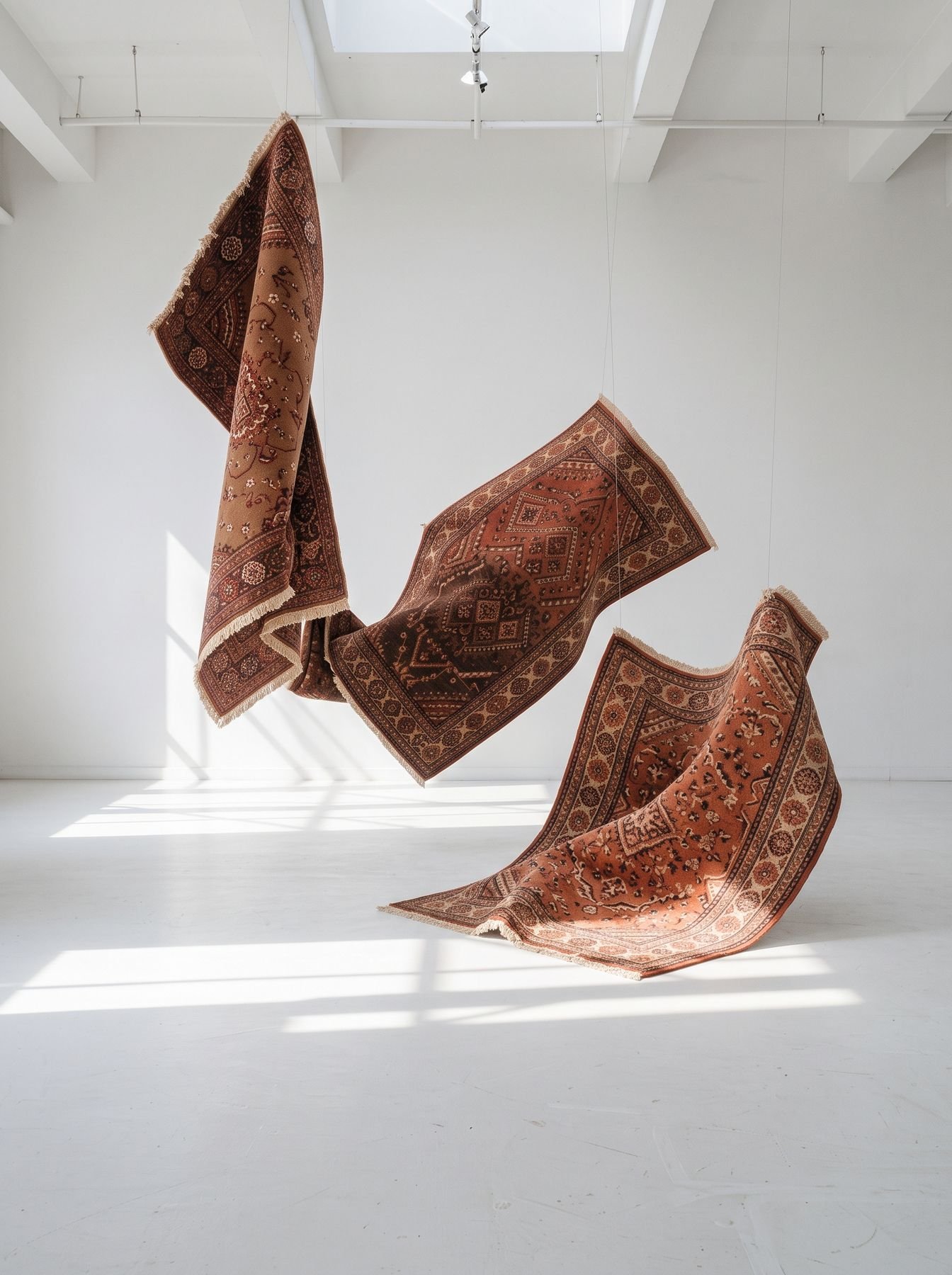
Carpets in Motion
This is a proposal, not a realised project. The images on this page were generated as drafts with Gemini; the videos and the interactive sketches are our own work.
A concept study we developed for a carpet brand, starting from one question: how does a centuries-old craft move through today’s spaces?
We treated the carpet not as an object resting on the floor but as a surface that shapes space.
Not realised
Motion Studies
We explored a digital language in which thread becomes weave and weave becomes form. Twelve short studies on the carpet curling, rippling, breaking into pixels and gathering again.
Interactive Sketches
Working sketches for setups where the visitor changes the surface by touching it or simply by moving. They run in the browser; three of them use the camera, and the image never leaves the device.
Particle carpet
The carpet breaks into 200,000 particles; as the pointer moves across it the pattern scatters and gathers again.
PointerWeaving by hand
Hands are tracked by the camera; the movement of the fingers takes the place of the thread on the loom.
Needs cameraKinetic surface
Hand movement deforms the surface of the carpet; the pattern stretches along the trace of the hand.
Needs cameraMotion by body
The whole body is tracked; a person walking through the space passes onto the carpet as a wave.
Needs cameraKinetik İşler Kolektifi
Gemini (AI drafts)
Claude
Proposal — not realised
ABOUT THE PROJECT
This is a concept study drawn from a proposal we prepared for a carpet brand. The work was never realised; what we share here is not an implementation but a way of thinking.
Our starting question was this: how does a centuries-old craft move through today’s spaces? In Anatolia the carpet has for centuries been an object that lies on the floor, is walked on, and wears down with time. What interested us was lifting it off the floor and thinking of it as a surface that shapes space — one that hangs from a wall, descends from a ceiling, spills towards the glass, and answers back when touched.
On the spatial side we worked on two headings. For trade fair stands we proposed installations that merge with physical carpets: arrangements where the digital surface carries on where the real carpet ends, and the boundary between the two blurs. For shop windows we designed setups in which the carpet curls out towards the glass and behaves like a volume standing in front of the person looking in from the street.
The second heading was interaction. We produced working sketches for surfaces the visitor alters by touch or simply by passing in front of them; the four studies above are those sketches themselves, not a description of them. In them we tested how hand and body movement read by a camera carries into the pattern, and how many particles a carpet can break into and still gather itself again.
In the videos we tried a separate language: short motion studies in which thread becomes weave and weave becomes form. Twelve studies that were, at the same time, a proposal for the tone of the brand’s social media content.
The scope of the proposal went beyond design. An archive-driven contemporary art exhibition telling the brand’s own history, talks and workshop programmes on carpet culture and design, sector research and article writing, objects designed specially for trade fair visitors, art direction for shoots. In other words not a visual language, but the whole of the relationship a brand builds with cultural production.
We do not name the brand here; what we share is not the work itself but our approach.